The Project MACRAMÉ developed, demonstrated, and validated different technologies, some of them integrated into intelligent, tiered testing approaches, that address market-relevant Advanced Materials (AdMas) both at possible exposure points and in relevant complex matrices. Therewith, MACRAMÉ pushed towards the availability of standards, OECD Test Guidelines and Guidance Documents. Within the Project duration, the technical readiness level (TRL) as well as the Regulatory Readiness Level (RRL) of the different methodologies was pushed forward and successfully increased. Here we summarise the increase in TRL for the different technologies within MACRAMÉ, explain the achievements and outline the next steps.
Technical Readyness Level (TRL)
The TRL is an indicator of the maturity level of a particular technology. This measurement system provides a common understanding of technology status and addresses the entire innovation chain. The TRL are described in more detail in the Annex G of the General Annexes to the Work Programme 2016/17. In brief they are:
- TRL 1 – basic principles observed
- TRL 2 – technology concept formulated
- TRL 3 – experimental proof of concept
- TRL 4 – technology validated in lab
- TRL 5 – technology validated in relevant environment (industrially relevant environment in the case of key enabling technologies)
- TRL 6 – technology demonstrated in relevant environment (industrially relevant environment in the case of key enabling technologies)
- TRL 7 – system prototype demonstration in operational environment
- TRL 8 – system complete and qualified
- TRL 9 – actual system proven in operational environment (competitive manufacturing in the case of key enabling technologies; or in space)
MACRAMÉ Methods and Tools
Figure 1 provides an overview of the TRL at the beginning of MACRAMÉ and the achieved TRL in each R&I Activities, positioning the MACRAMÉ Project firmly in the ‘lab to market’ field. All open access publications can be found in the MACRAMÉ Publication Portfolio, providing in-depth descriptions of the advancements in technical and regulatory readiness levels.
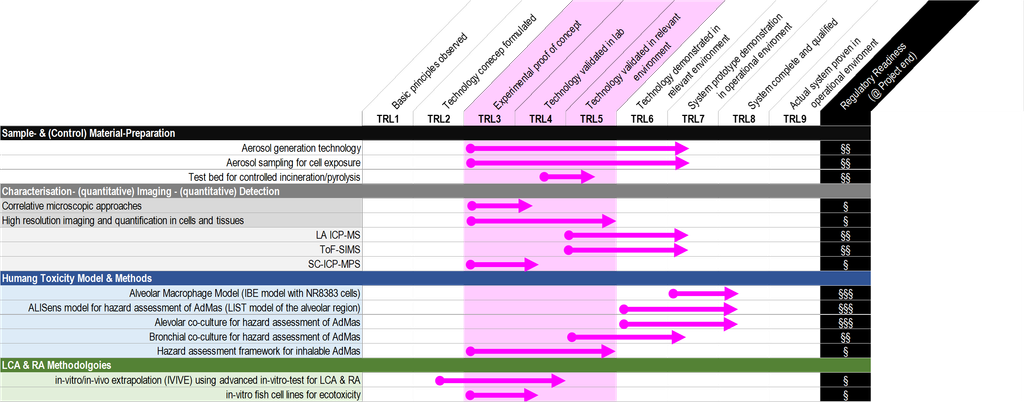
Within MACRAMÉ novel conceptual and technical approaches for the aerosol generation and the aerosol sampling for cell exposure, with controlled dosimetry & particle morphology, were developed and are leading to standardised experimental frameworks with well-defined modules adapted to the desired study design (sample nature, cell model requirements, etc.). The publication describing the limits and advantages of each method with representative chemicals is under preparation and the methods will be further validated by MACRAMÉ Partners.
A pre-validated incineration SOP was developed and employed for Use Cases 1, 2 and 4, and another SOP described how to retrieve soot particles from filters to be used in cell culture experiments.
The correlative microscopy approaches (SEM + Raman) and high-resolution imaging and quantification in cells and tissues with Raman achieved TRL 4 and MACRAMÉ Partner BAuA is continuing the validation.
LA-ICP-MS and ToF-SIMS increase to TRL 7 due to increased standardization, automation and evaluation routines (detailed in D2.7). The usefulness of ToF-SIMS for high-resolution imaging of various carbonaceous AdMas in cells (especially macrophages) was demonstrated. ToF-SIMS was employed to analyse samples from all use cases. The combination with other characterisation techniques as light microscopy, fluorescence microscopy, and CRM for correlative imaging approaches worked well and delivered semi-quantitative data on the particle distribution in cells. Strategies for more efficient analyses (less time-consuming) have been developed. Single Cell ICP-MS (SC-ICP-MS) requires cell samples to be injected as individual objects to be measured one by one by the ICP-MS. The sample preparation, the adherence of the sample to the walls of the injection system and the analysis parameters are crucial for this type of measurement.
MACRAMÉ did stress-test, validate and implement several biological models representative of the human respiratory system, including models of upper (bronchial region) and lower (alveolar region) airways. MACRAMÉ’s biological systems used existing technology at different TRLs. Before, validation of such models has been performed on chemicals, respirable particles, and nanomaterials rather than AdMa@CMs. MACRAMÉ demonstrated the usefulness of the proposed biological systems for hazard assessment of AdMas and regulatory practice. The Alveolar Macrophage Assay is published. The ALIsens model is commercially available through the Invitrolize company and is brought to the OECD. The Alveolar and Bronchial co-cultures are successfully used for dose finding experiments and to assess cytoxicity and inflammatory potential.
MACRAMÉ optimised analytical methods and improved biological systems for inhalation hazard assessment of AdMas at different stages of their life cycle. The scientific outcomes towards the in vitro Hazard Assessment of inhalable Materials were summarised and will support the development of an OECD GD (detailed in D2.8).
Within MACRAMÉ an in vitro to in vivo extrapolation (IVIVE) approach for hazard assessment was developed, with the aim of translating in vitro concentration–response data into equivalent in vivo exposure levels. Using a reverse dosimetry framework, in vitro effect concentrations derived from dose–response modelling were linked to external exposure concentrations through toxicokinetic modelling. The approach was applied to UC3, focusing on a sheet-like graphene material contained in a silicone–graphene aerosol.
MACRAMÉ extended the existing OECD TG 249 Rainbow Trout Fish gill cell toxicity tests by implementing it as an in vitro barrier model, enabling acute and sub-chronic evaluation of AdMas. Within MACRAMÉ the existing OECD TG 249 Rainbow Trout Fish gill cell toxicity tests was extended by implementing it as an in vitro barrier model, enabling acute and sub-chronic evaluation of AdMas. It was used to evaluate the Use Case materials (UC1, UC2, UC3, and UC5).
More detailed descriptions are available in the MACRAMÉ Publication Portfolio.