Swaroop Chakraborty and Iseult Lynch from MACRAMÉ Partner University of Birmingham published an article on the influence of biocorona around engineered nanomaterials (ENM) on their environmental fate.
ENMs have revolutionized biomedicine, energy, and environmental remediation due to their unique physicochemical properties. However, these properties are not static; they evolve dynamically as ENMs interact with real-world biological and environmental systems. Central to this transformation is the formation of the biomolecular corona, a dynamic layer of adsorbed proteins, lipids, and metabolites that govern how nanomaterials interface with their surroundings.
The corona alters the surface chemistry, colloidal stability, and biological identity of an ENM, ultimately dictating its environmental fate, functionality, and safety profile, but also evolves as the surroundings change or as the living system responds to the presence of the nanomaterials and secreted biomolecules.
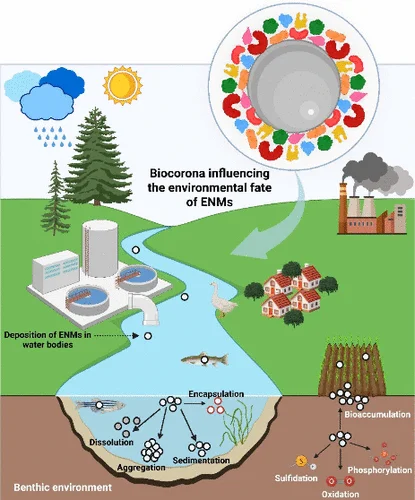
Over the past decade, the authors’ and other experts’ research has elucidated how biomolecule-driven transformations, such as dissolution, ion release, sulfidation, enzymatic degradation, and redox reactions, can be modulated by the acquired corona. These processes not only determine the longevity and toxicity of nanomaterials but also offer programmable opportunities for safe degradation or detoxification.
While the biomolecular corona concept is well-established for engineered nanomaterials such as metal and polymeric nanoparticles, it is now extending to emerging materials such as metal–organic frameworks (MOFs). These hybrid, porous materials are increasingly used in biomedical, catalytic, and environmental applications, yet their transformations under biological and ecological conditions remain largely uncharted.
The authors’ recent work demonstrates that protein coronas can either stabilize or destabilize MOFs, modulate enzyme function, or even program degradation via enzyme-sensitive linkers. These findings provide the foundation for safe-by-design and corona-informed design strategies, where materials are engineered to respond predictably to biological cues.
Read the full text publication here.