The ‘Joint Risk Assessor Summit on Advancing Safety & Sustainability Assessments of Advanced Materials’ hosted at the Organisation for Economic Cooperation and Development (OECD) in Paris and co-organised by four Horizon Europe projects ACCORDs, iCARE, MACRAMÉ, and nanoPASS, was a full success. Now, the full report of the event is available.
The Joint Regulatory Risk Assessors Summit gathered over 80 participants from regulatory authorities, academia, industry, and international organisations. The event aimed to explore how advanced materials can be assessed more effectively for safety and sustainability, and how innovation in materials and products can better align with regulatory expectations.
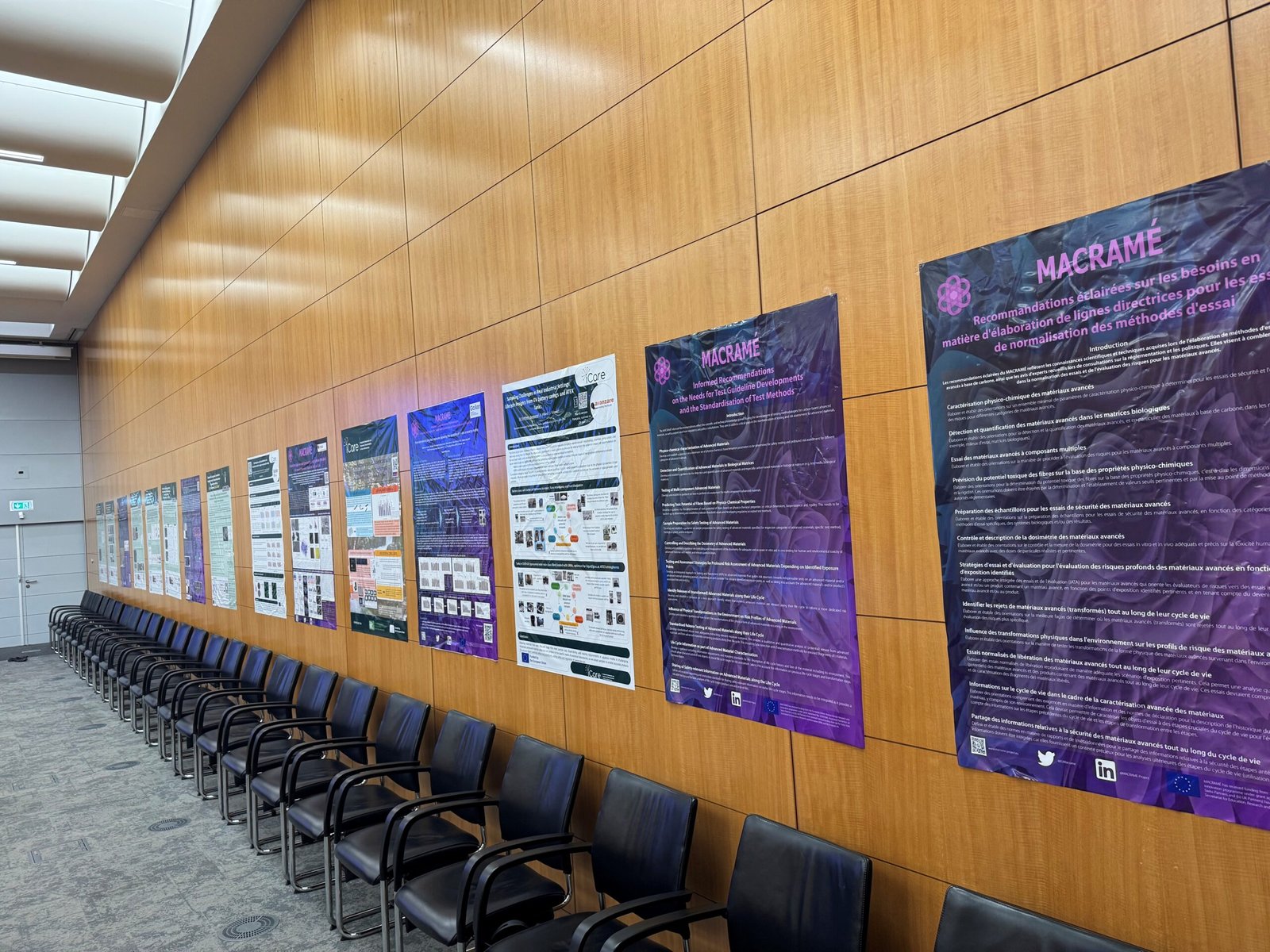
Over the course of two days (19-20 June 2025), the summit provided a platform to present both current challenges towards test methods applicable to advanced materials and concrete advances from the four EU projects. These included new tools and approaches for material characterisation, in vitro and in silico methods for hazard assessment, and strategies for life cycle analysis and exposure modelling. Discussions extended beyond regulatory uptake, covering practical implementation, data integration, and cross-disciplinary collaboration.
Breakout sessions invited participants to reflect on physical-chemical characterisation, human toxicology, and environmental fate, as well as overarching cross-cutting themes such as stakeholder engagement, validation processes, and communication challenges. In this context, the draft Informed Recommendations developed within the MACRAMÉ project were presented to stimulate discussions, contributing to broader conversations on test method development, standardisation, and regulatory uptake.
Across sessions, there was strong consensus on several points: the need for pragmatic and cost-efficient test methods, early and continuous dialogue between research and regulation, and improved coordination between stakeholder groups. Digital tools, FAIR data (i.e. Findable, Accessible, Interoperable, Reusable), and artificial intelligence (AI)-based approaches were widely seen as future enablers, though concerns remain regarding validation and acceptance. A frequently raised concern was the lack of sustained and strategically coordinated funding to bridge the gap between innovation and regulatory compliance.
The summit underscored that advancing safe and sustainable innovation of advanced materials depends not only on technical excellence but on openness, shared priorities, and long-term collaboration.
The full report is available here.