Experts from the MACRAMÉ Partner University of Birmingham published a paper on the PM2.5-induced multinucleation of bronchial epithelial Cells caused by microtubule overacetylation and disruption of microtubule-associated proteins. The formation of multinucleated cells is associated with abnormal mitosis, which can lead to uncontrolled cell proliferation and even malignant transformation due to the continuous increase in chromosomal instability.
In a previous study it was first discovered that PM2.5 induces a decrease in microtubule dynamics and promotes the formation of multinucleated cells in the human bronchial epithelial cell line (BEAS-2B). To elucidate the intrinsic mechanism by which PM2.5 causes multinucleation in bronchial epithelial cells, the authors conducted in vivo experiments using C57BL/6J mice exposed to PM2.5 via intratracheal instillation, as well as in vitro mechanistic studies using BEAS-2B cells. To verify the involvement of the PI3K/Akt/GSK-3β signaling pathway, we employed PI3K inhibitor LY294002 and GSK-3β-overexpressing BEAS-2B cells. In both in vivo and in vitro experiments, an increase in multinucleated cells was observed following PM2.5 treatment.
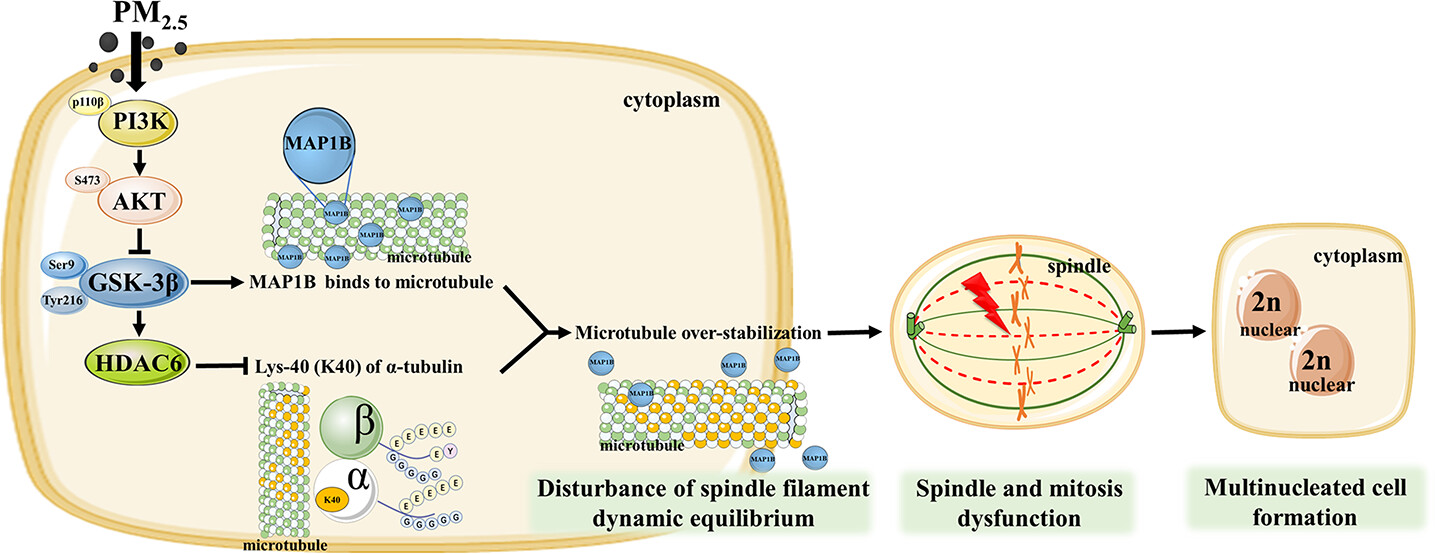
Additionally, PM2.5 directly led to a higher proportion of polymerized microtubules and abnormal microtubule aggregation. In the mechanistic studies, the authors investigated the impact of PM2.5 on the microtubule dynamics. The results demonstrated that PM2.5 activated the PI3K/Akt/GSK-3β signaling pathway, which inhibited the deacetylase enzyme HDAC6, resulting in excessive microtubule acetylation. Simultaneously, PM2.5 induced the dissociation of microtubule-associated protein MAP1B from the microtubules. Both processes contributed to the overstabilization of microtubule proteins. However, mitosis requires highly dynamic microtubules, characterized by rapid switching between growth and shrinkage. Therefore, the overstabilization of microtubule proteins induced by PM2.5 reduced the microtubule dynamics and disrupted spindle function during mitosis, ultimately leading to mitotic failure and the formation of multinucleated cells.
Read the full-text publication following this link.