MACRAMÉ colleagues from EMPA and Epithelix have published a paper entitled ‘Silicon Carbide Nanowires Impair Mucociliary Clearance-Mediated Innate Immunity in Primary Human Bronchial Epithelial Cells‘.
In this study, the fate of zero-dimensional, one-dimensional, and two-dimensional silicon- and carbon-based nanomaterials (silicon carbide nanowires (SiC NWs), silicon dioxide (SiO2), multiwalled carbon nanotubes (MWCNTs), and graphene nanosheets) in airway mucus was investigated for the first time. The respiratory tract possesses mucociliary-driven innate immune defense mechanisms that protect the lungs from harmful environmental exposures, but when damaged, increase susceptibility to respiratory infections and diseases. Inhalation exposure to certain nanomaterials has been shown to trigger fibrosis and other respiratory conditions. However, there is a limited understanding of whether nanomaterials can impair mucociliary defense in lungs and its underlying mechanism. The study was designed such that the investigation of the interactions of nanomaterials (SiC NWs, SiO2 NPs, Graphene nanosheets, MWCNTs) and crystalline silica (Quartz DQ12, Reference Particle) with respiratory mucus was characterised using a range of biophysical analytical approaches.
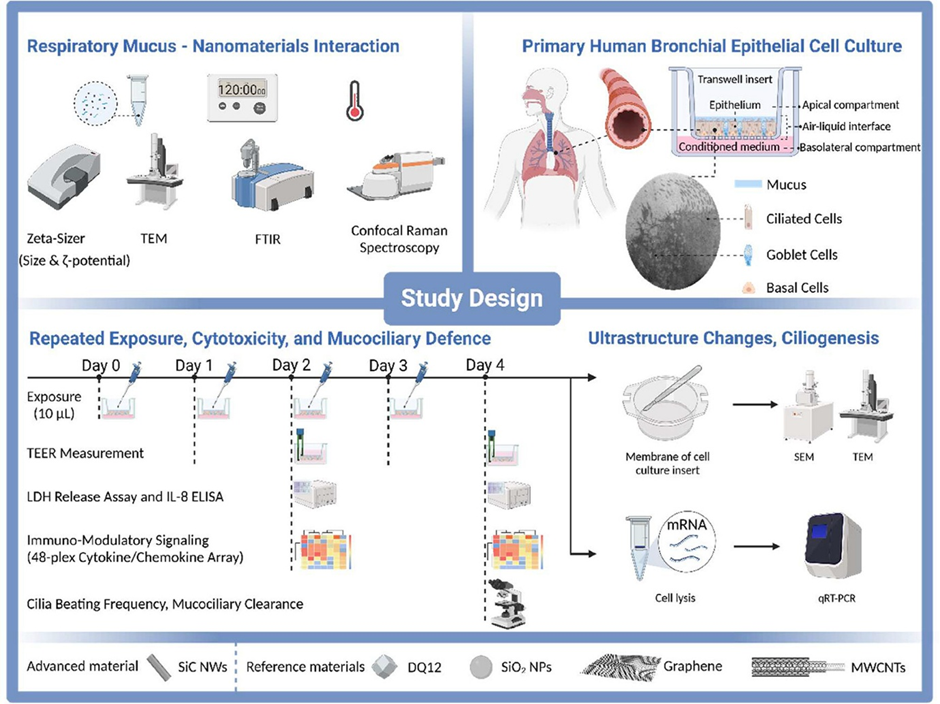
The results of the study demonstrated that only SiC NWs escaped through the mucus gel without interactions, suggesting their potential to diffuse across the protective mucus layer. The hydrophobicity of the SiC NWs, associated with the low abundance of polar surface groups, such as silanols, was mainly responsible for the observed shielding of particle interactions with mucus components. Furthermore, repeated exposure to SiC NWs in primary bronchial epithelial cell cultures revealed abnormal ciliary structure and significantly (p < 0.05) compromised mucociliary clearance functions, however, no such effects were evident for other particles. mRNA expression analysis showed a significant (p < 0.05) increase in FOX-J1 transcripts, suggesting transcriptional dysregulation of ciliogenesis after exposure to SiC NWs. Finally, SiC NWs reduced epithelial barrier integrity and promoted pro-inflammatory and pro-fibrotic responses. The findings unravel the hazardous potential of SiC NWs upon inhalation exposure and identify the breaching and impairment of the mucociliary innate defense as a key event in their respiratory toxicity.
Follow this link to read the full publication.