The EU Commission had opened a call for evidence and a public consultation, seeking input from various stakeholders for the Advanced Materials Act, which aims at establishing a strategic framework for advanced materials that is crucial for industrial leadership, strategic autonomy and competitiveness in the EU.
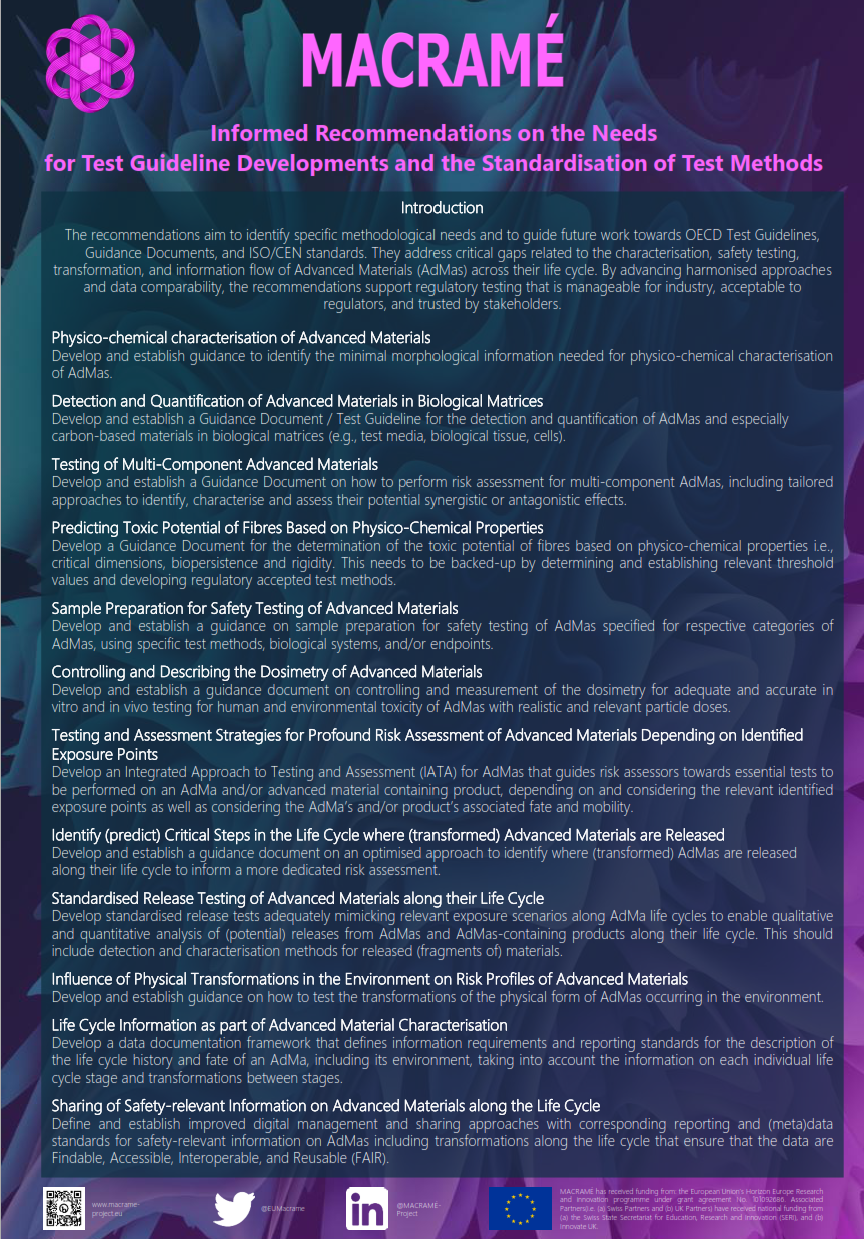
With the expertise brought together in MACRAMÉ and the experiences gained throughout the project duration, MACRAMÉ responded to the call for evidence. MACRAMÉ acknowledged the initiative by the Commission to strengthen research, innovation and uptake of advanced materials (AdMas) in Europe. MACRAMÉ emphasised the importance of purposeful measures towards the development of safe and sustainable AdMas. Developing adequate safety test methods, considering entire lifecycles of AdMas and connecting different experts is strongly encouraged. MACRAMÉ aimed at providing constructive feedback also in the public consultation questionnaire. As the questions mainly address innovators, unfortunately, MACRAMÉ does not find itself in the questions posed. The full response to the call for evidence is publicly available. It includes a one-pager about the MACRAMÉ Informed Recommendations.
The following key aspects are highlighted:
- Appropriate, cost-effective, regulatory relevant and predictive test methods are pivotal to achieve a significant acceleration of design, development and testing of AdMas
By advancing harmonised and standardised approaches, data flow and comparability, safety testing is manageable for industry, acceptable to regulators, and trusted by stakeholders. AdMas’ complexity affects all stages of testing, from sample preparation and exposure design to endpoint selection and data interpretation. Funding needs to cover all phases of test method establishment. MACRAMÉ is a thriving example of successful development and pre-validation of advanced test methods for carbon-based AdMas. Beyond having developed new test methods, MACRAMÉ has also formulated recommendations that address critical gaps in test methods related to the characterisation, safety testing, transformation, and information flow of AdMas across their lifecycles. - Clarity of the scope leads to success
The results of MACRAMÉ emphasize the usefulness of the OECD WPMN working description of AdMas that avoids a strict definition. Including a broad range of AdMas in the Act enables multifaceted innovation – from early research to large-scale deployment. - Knowledge exchange is essential
Promoting innovation and reducing time to market without undermining the achievement of environmental and human safety objectives, as aspired by the Act, is essential for strengthening industrial competitiveness and resilience. The proposed regulatory sandboxes can only be effective tools for advancing regulation if experts on regulation and risk assessment are enabled to interact with researchers, innovators from start-ups and other industrial players to develop a mutual understanding of the benefits and risks of novel materials.