MACRAMÉ colleagues from BAuA and IBE together with experts from the German BfR have published an extensive study on the behaviour of Macrophages when they encounter fibres.
The authors exposed NR8383 rat alveolar macrophages to three silver nanowire variants differing in diameter and length. Time-lapse microscopy captured fibre uptake processes. The authors observed a macrophage that was bending an exceptionally long fibre (~ 140 µm) first into an arc and then a spiral for full internalization, initiated by a pseudopod extending along the fibre and buckling the internalized segment.
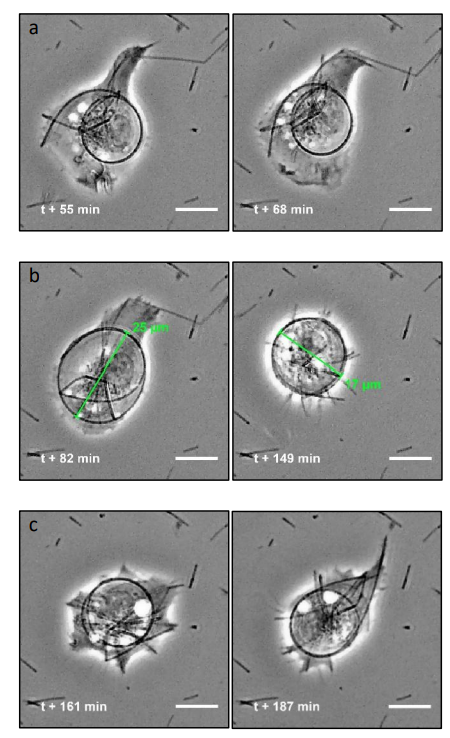
Observations of macrophage-fibre interactions. a, After taking up the long silver nanowire of the aged G-Rods3170 variant, the macrophage continued to take up a fibre with an extended pseudopod (left panel), initiating bending, which results in higher curvature of the fibre (right panel). b, Afterwards, the cell increased its size to ca. 25 µm and the fibre spring extended (left panel). The macrophage attempted to constrain the fibre by decreasing its size to ca. 17 µm (right panel). c, The cell maintained the shape of the fibre spiral while still actively extending pseudopodia (left panel), but after more than three hours after the initial bending event at time, the macrophage seemed to allow unwinding of the nanowire with the tips poking and stretching the cell membrane (right panel). Scale bars in a-c represent 10 µm. (Source: Broßell, D., Meyer-Plath, A., Gräb, O. et al. Macrophages bend long fibres with flexural rigidity lower than 3 mN·nm2 to avoid frustrated phagocytosis. Part Fibre Toxicol 23, 15 (2026). https://doi.org/10.1186/s12989-026-00666-9  )
)
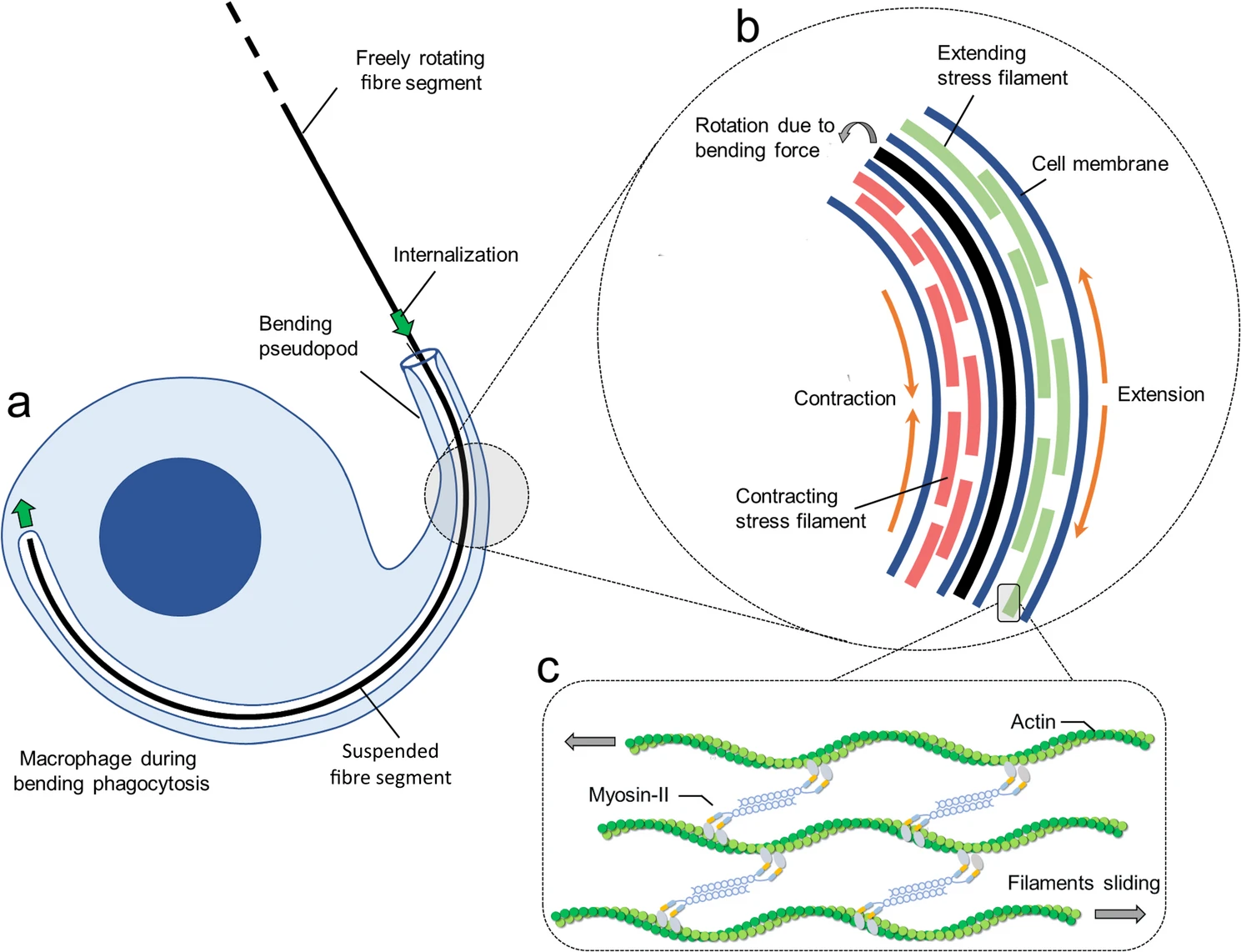
A mechanical model was developed by combining established cytoskeletal biophysics with the observed fibre deformation dynamics. As flexural rigidity describes fibre behaviour under load, our model estimated rigidity by reproducing the observed bent fibre shape. It yielded a flexural rigidity of 20 mN·nm² for the fibre bend by the macrophage in the observation. Using the conservative lower bound, long and biodurable fibres with a rigidity lower than 3 mN·nm² are expected to be readily cleared by NR8383 rat alveolar macrophages. Although this rigidity scale may not be directly translatable to humans, the experimental findings and their modeling emphasize the key role of rigidity in fibre–cell interactions. Fibre rigidity is therefore central for material safety aspects and sustainable product design.
It is an established toxicological principle that the inhalation pathogenicity of respirable and biodurable fibres is caused by excessive fibre length as alveolar macrophages fail to uptake and remove such fibres. However, studies on carbon nanotubes showed that this principle needs revision, as thin, flexible variants showed reduced fibre-specific toxicity. One potential explanation is that the low flexural rigidity of thin fibres enables macrophages to bend and internalize even those that are long relative to the cell size. To evaluate this proposed “rigidity hypothesis,” the mechanisms governing the uptake of flexible long fibres that determine a critical threshold value for flexural rigidity require clarification.
The full text publication can be found here.